By Cibes Lift Philippines · Home Elevator Specialists · Updated April 2026
TL;DR
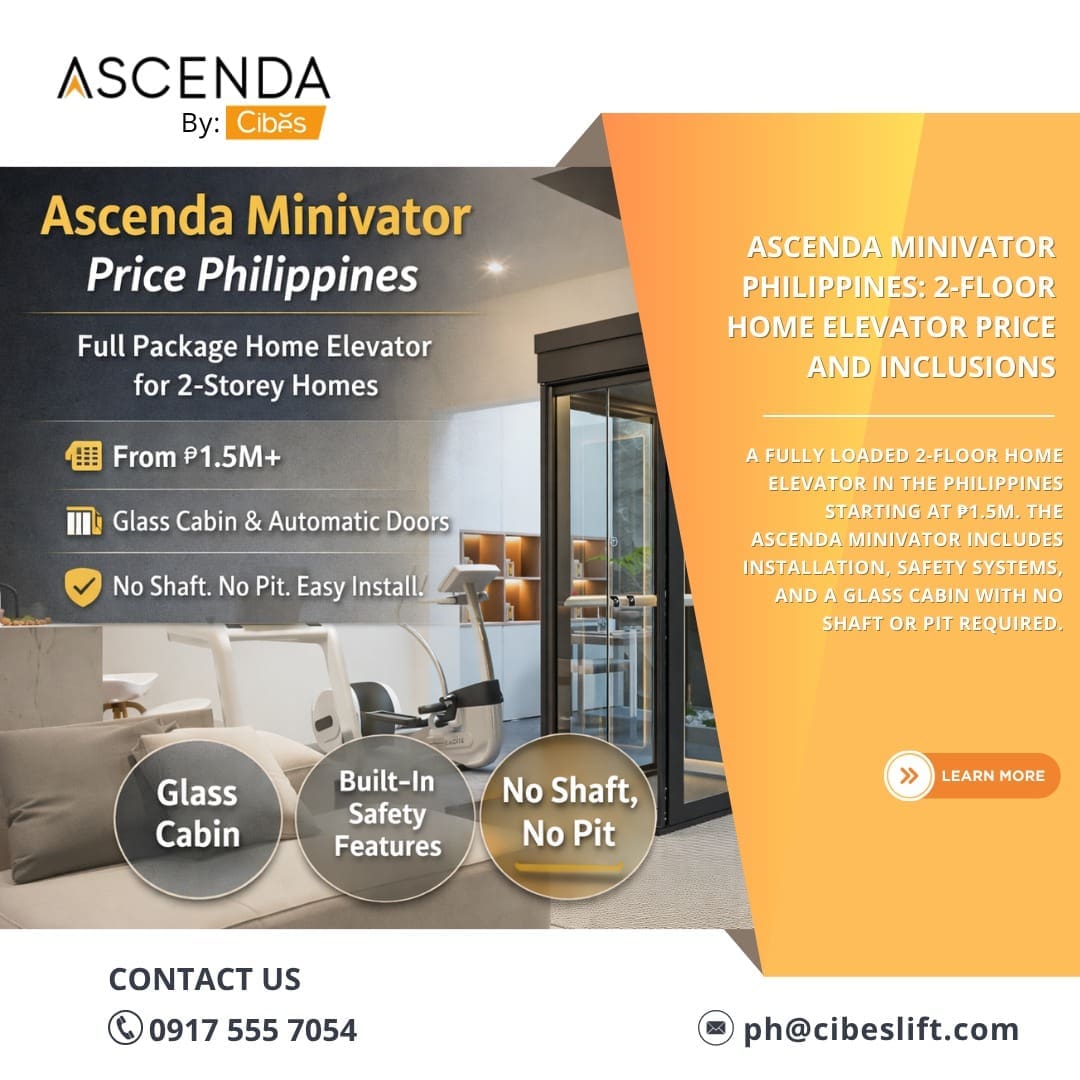
The Ascenda Minivator is a 2-floor home elevator priced around ₱1.5M to ₱2M+ in the Philippines. It comes as a complete package with a glass cabin, automatic doors, built-in safety features, and installation. No shaft, no pit, and minimal construction needed. Ideal for compact homes and retrofit projects.
What is the Ascenda Minivator and who is it for?
The Ascenda Minivator is a shaftless home elevator designed for two-storey residential homes.
It works well for:
- Elder or families planning ahead
- Homes with limited space
- Renovations or retrofit setups
- Owners who want minimal construction
No deep pit. No machine room. No complex build.
Just a straightforward lift solution for daily use.
What does “fully loaded” really mean?
“Fully loaded” here means most features are already included in the base price.
Complete system inclusions:
| Component | Included |
|---|---|
| Enclosed glass cabin | Yes |
| Automatic saloon doors | Yes |
| Fold-down seat | Yes |
| LED lighting and ventilation fan | Yes |
| Dual controls (inside and outside) | Yes |
| App monitoring | Yes |
So what you see upfront is close to what you actually pay.
What safety features come standard?
Safety isn’t optional. It’s part of the system.
| Feature | Function | Standard |
|---|---|---|
| Safety pan | Detects obstruction and stops the lift | Yes |
| Emergency stop | Immediate stop control | Yes |
| Battery backup | Lowers lift during brownout | Yes |
| Manual lowering | Backup descent system | Yes |
| Emergency phone | Built-in communication | Yes |
| Weight sensor | Prevents overload | Yes |
The system follows EN 81-41, a recognized international standard for home lifts.
What are the technical specifications of the Ascenda Minivator?
| Specification | Detail |
|---|---|
| Max load | 350 kg |
| Speed | 0.15 m/s |
| Travel height | Up to 3.8 meters |
| Power supply | 230 to 240 V |
| Motor | 2.7 kW |
| Drive system | Screw drive |
| Floors served | 2 floors |
| Pit requirement | None |
| Warranty | 2 years |
| Maintenance frequency | 1 to 2 times per year, depending on usage |
Maintenance is usually once or twice a year for residential use.
What are the available sizes and which one fits your home?
Size affects both usability and price.
| Size | Floor area (approx.) | Max load | Wheelchair friendly |
|---|---|---|---|
| S | Under 1.2 sqm | Up to 250 to 300 kg | No |
| M | Around 1.2 sqm | Up to 300 kg | Limited |
| L | Larger footprint | 350 kg | Yes |
| XL | Maximum size | 350 kg | Yes |
If wheelchair access is needed, L or XL is the safer choice.
A site inspection confirms what fits your layout.
How much construction is needed?
Compared to traditional elevators, installation is simpler.
| Step | What happens |
|---|---|
| Floor opening | A cut-out is created between levels |
| Structural fixing | Lift is anchored at key structural points |
| Electrical connection | Uses standard home power |
No excavation. No deep pit. No heavy structural work.
That’s why it’s often used for existing homes.
Where can you install it?
The Minivator can fit in different areas of the house:
- Stairwell voids
- Corners of rooms
- Beside stairs
- Unused vertical space
Even compact homes can usually accommodate smaller sizes.
Is the Ascenda Minivator worth the price?
It depends on your needs, but here’s the simple view.
You’re getting:
- A complete system, not a base unit
- Built-in safety features
- Minimal construction work
- A long-term mobility solution
If ease of use and space efficiency matter, it’s a practical choice.
Real installations in Philippine homes
A homeowner in Quezon City installed an L-size unit after knee surgery made stairs difficult. The lift was placed beside the staircase and completed in just a few days.
In Laguna, an M-size unit was installed in a tight corner space. No major structural work was needed, which kept the process simple.
Every home is different, so layout checks are always part of the process.
What are the limitations you should know?
There are a few limits to keep in mind:
- Designed for 2 floors only
- Max travel height is up to 3.8 meters
- Larger sizes need enough floor space
- Some older homes may need structural assessment
A proper site visit confirms if it’s a good fit.
Frequently asked questions about Ascenda Minivator Philippines
Q: Does it need a shaft or pit?
A: No. It’s a shaftless system with no deep pit required.
Q: Can it be installed in an existing house?
A: Yes. It works for both new builds and retrofit projects.
Q: Is it safe during power outages?
A: Yes. The battery backup lowers the lift safely during a brownout.
Q: Is it wheelchair accessible?
A: Yes, for L and XL sizes, depending on available space.
Q: Are there hidden costs?
A: Most core features are already included, so pricing is more predictable.
Q: Planning your home elevator?
A: If you’re considering a home elevator, the next step is simple.
A site check helps confirm:
- What size fits your space
- Final pricing based on layout
- Installation requirements
That’s usually where everything becomes clear.
What is the first step to install a home lift in my house?
Choosing the right lift involves understanding your space, structure, and long-term needs. A site assessment helps determine the best installation method and size.
Contact a qualified lift provider to discuss your home layout and options.