By Cibes Lift Philippines · Home Elevator Specialists
TL;DR
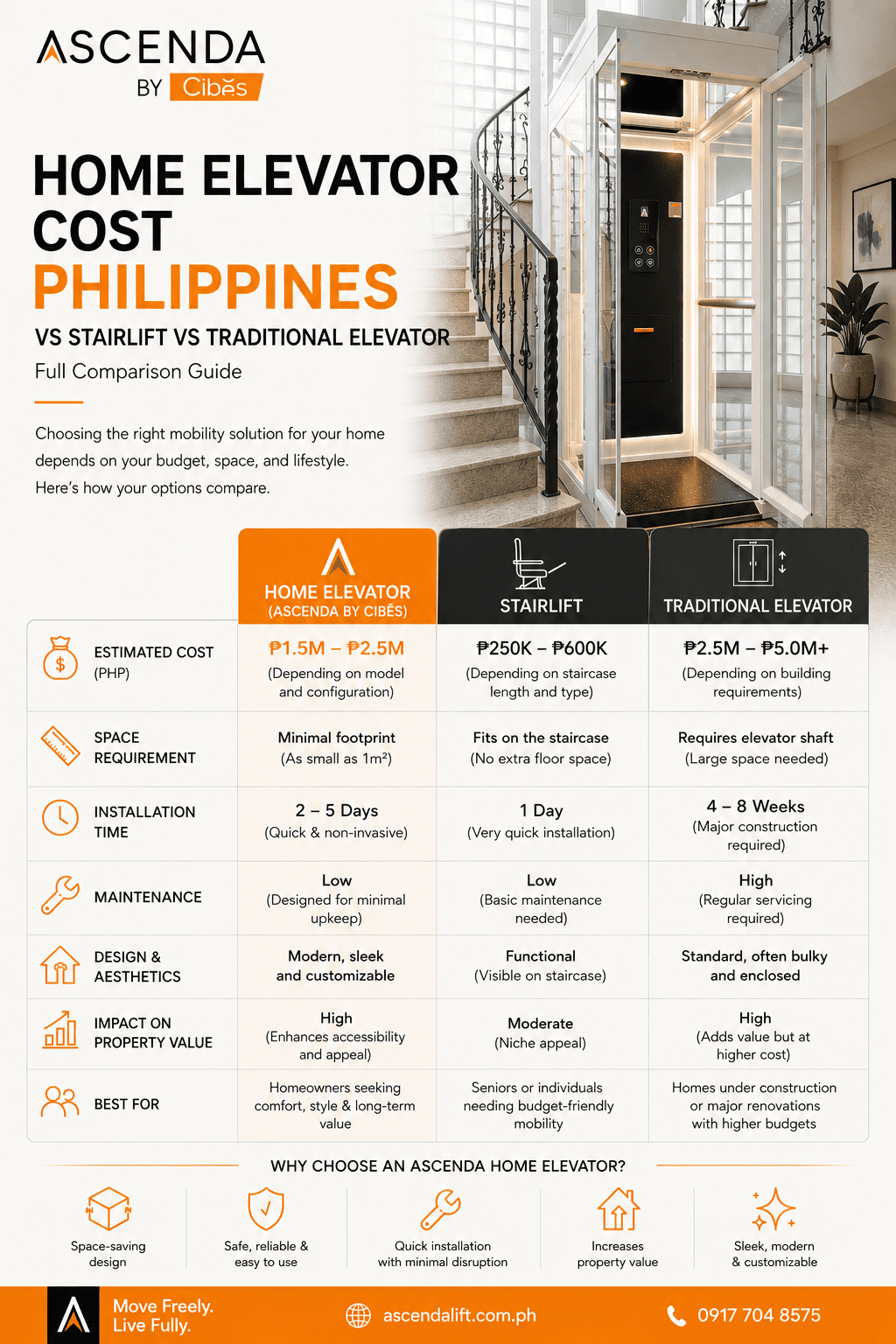
In the Philippines, stairlifts usually cost less upfront, but they only work for one person at a time and depend on existing stairs. Traditional elevators cost the most because they require deeper construction, machine rooms, and larger shafts. Modern home elevators like Ascenda by Cibes sit in the middle. They offer easier access, cleaner design, lower structural requirements, and better long-term convenience for many Filipino homes.
For most two-storey and multi-level homes in Metro Manila, Rizal, Laguna, Cavite, Cebu, and Davao, compact home lifts are becoming the practical middle ground between expensive commercial elevators and limited stairlift systems.
Why Are More Filipino Homeowners Comparing Home Elevators?
The Philippine housing market has changed.
More families now build taller homes because lot sizes in cities are getting smaller. In areas like Quezon City, Makati, Pasig, Antipolo, Cebu City, and Davao, vertical living is becoming normal. Three-storey homes are no longer rare.
At the same time, many Filipino households are multi-generational. Parents, grandparents, children, and helpers often live under one roof. Stairs eventually become tiring, inconvenient, or unsafe.
That is why searches for these terms continue to rise:
- home elevator Philippines
- home lift cost Philippines
- residential elevator Philippines
- stairlift Philippines price
- elevator for house Philippines
- wheelchair lift Philippines
- compact home lift
- two-storey house elevator
- modern home elevator Philippines
Filipino homeowners are no longer asking if home lifts are possible.
They are asking:
Which system actually makes sense for my home and budget?
What Is the Difference Between a Home Elevator, Stairlift, and Traditional Elevator?
Before comparing costs, it helps to understand how each system works.
What Is a Stairlift?
A stairlift is a motorized chair attached to a rail along the staircase.
The user sits on the chair and rides up or down the stairs.
Stairlifts are commonly used for:
- Seniors with mobility issues
- Temporary recovery after surgery
- Homes where major renovation is not possible
However, stairlifts depend entirely on the staircase layout.
They also move only one seated passenger at a time.
What Is a Home Elevator or Home Lift?
A home elevator, also called a home lift or residential elevator, is a compact vertical lift designed for private houses.
Modern systems like Ascenda by Cibes use space-saving technology that reduces structural work compared to traditional commercial elevators.
Many Filipino homeowners choose compact home lifts because they:
- Fit smaller urban homes
- Require less civil work
- Work for seniors and wheelchair users
- Improve daily convenience
- Add long-term accessibility
According to Ascenda by Cibes Philippines, modern home lifts are increasingly used in multi-storey homes where homeowners want safer movement between floors without major structural disruption.
What Is a Traditional Elevator?
Traditional elevators are the large systems commonly used in:
- Condominiums
- Hotels
- Office towers
- Hospitals
- Commercial buildings
These elevators usually require:
- Deep pit excavation
- Large concrete shaft
- Machine room
- Heavy-duty electrical requirements
- Extensive structural preparation
While they are powerful and suitable for high-rise buildings, they are often excessive for standard residential houses.
Home Elevator Cost Philippines: Comparison Table
Here is a general cost comparison for residential vertical mobility systems in the Philippines.
| Tier | Estimated cost (PHP) | Typical setup |
|---|---|---|
| Entry-level | From ₱1,500,000 | 2 to 3 floors, standard design |
| Mid-range | ₱2,000,000 to ₱3,000,000 | Custom finishes, more stops |
| Premium | ₱3,000,000 and above | High-end design, full customization |
Actual pricing depends on:
- Number of floors
- Lift size
- Glass or custom finishes
- Site condition
- Power requirements
- Imported components
- Installation complexity
- Indoor vs outdoor placement
In many Philippine residential projects today, compact home elevators provide the best balance between usability, aesthetics, and construction practicality.
Which Option Is Best for Small Philippine Homes?
This matters a lot in the Philippines.
Many homes in Metro Manila subdivisions and urban areas have limited floor space.
A traditional elevator often needs:
- Large shafts
- Deep pit excavation
- Machine rooms
- Bigger structural clearance
That can become difficult inside narrow residential lots.
Stairlifts save space but visually dominate the staircase. They also limit stair usage for other family members.
Compact home lifts are now popular because many models:
- Need minimal pit depth
- Do not require machine rooms
- Fit compact layouts
- Integrate into modern interiors
- Work for retrofit projects
This is especially relevant for:
- Townhouses
- Duplex homes
- Split-level homes
- Modern minimalist houses
- Multi-generational homes
Which Is Better for Seniors and Aging in Place?
For aging homeowners, convenience is only part of the story.
Safety matters more.
Stair-related accidents remain one of the biggest concerns inside multi-level homes.
A stairlift can help one person move between floors, but it may not work well for:
- Wheelchair users
- Carrying groceries
- Household movement
- Multiple passengers
- Long-term accessibility planning
Home elevators offer more flexibility because users can:
- Ride while standing or seated
- Bring mobility aids
- Carry household items
- Move more comfortably during humid weather
- Reduce physical strain
Ascenda home lift future-proofing guide explains that many Filipino families install home lifts to support aging in place and maintain long-term comfort inside multi-storey homes.
This trend continues growing more homeowners plan ahead instead of waiting for mobility problems to happen.
Which System Requires the Most Construction?
Stairlift Construction Requirements
Usually minimal.
The rail attaches directly to the staircase.
However:
- Stair shape matters
- Curved stairs cost more
- Narrow staircases may become cramped
- Some layouts may not work at all
Home Elevator Construction Requirements
Modern home lifts generally require less construction than commercial elevators.
Depending on the model, installation may involve:
- Compact shaft preparation
- Minor pit work
- Electrical setup
- Structural reinforcement
Many newer systems are designed specifically for residential retrofits.
That is one reason why compact home elevators are growing in popularity across Philippine residential projects.
Traditional Elevator Construction Requirements
Traditional elevators usually require the most civil work.
This may include:
- Deep pit excavation
- Machine room construction
- Large concrete shafts
- Heavier structural reinforcement
- Complex engineering requirements
For many houses, this increases both timeline and total construction cost significantly.
Which Option Looks Better Inside Modern Filipino Homes?
Aesthetics matter more than people admit.
A stairlift is functional, but it often looks medical or temporary.
Traditional elevators can look impressive, but they may feel oversized inside standard residential houses.
Modern home elevators are designed differently.
Many now feature:
- Scandinavian-inspired design
- Glass panels
- Compact footprints
- Minimalist finishes
- Soft lighting
- Quiet operation
Ascenda by Cibes highlights Scandinavian design and screw-driven technology as part of its residential lift systems for modern homes. (ascenda-elevator.com)
For homeowners building premium residences in areas like Alabang, Quezon City, Cebu, and Antipolo, aesthetics have become part of the buying decision.
What Is the Maintenance Difference?
Maintenance costs vary depending on the system.
Stairlift Maintenance
Generally lower initially.
But stairlifts may experience:
- Rail wear
- Battery replacement
- Chair mechanism issues
- Stair obstruction concerns
Home Elevator Maintenance
Modern residential lifts are typically designed for lower residential usage compared to commercial systems.
This can mean:
- Simplified maintenance
- Reduced wear from heavy traffic
- Easier residential servicing
Choosing a provider with local after-sales support is important.
According to Cibes Lift Philippines, factory-direct after-sales service and locally trained technicians remain major factors for homeowners choosing long-term lift providers.
Traditional Elevator Maintenance
Commercial-style elevators often involve:
- More complex servicing
- Higher maintenance costs
- Specialized parts
- Commercial-grade inspections
For many residential homeowners, this becomes unnecessarily expensive over time.
Which Option Adds More Property Value?
Property value depends on market perception.
In premium Philippine residential markets, accessibility features are increasingly viewed as long-term assets.
A stairlift may help specific mobility needs, but it usually appeals to a narrower buyer group.
A modern home elevator may improve:
- Long-term usability
- Accessibility appeal
- Luxury perception
- Multi-generational functionality
- Convenience for future buyers
Traditional elevators may add prestige in ultra-luxury homes, but they are often impractical for average residential properties.
In many cases, home lifts provide the strongest balance between functionality and resale appeal.
What is the first step to install a home lift in my house?
Choosing the right lift involves understanding your space, structure, and long-term needs. A site assessment helps determine the best installation method and size.
Contact a qualified lift provider to discuss your home layout and options.